
Annealing: What It Is, How It Works, and Why It Matters for 3D Printed Parts
Annealing is a heat-treatment process used to relieve internal stress, increase strength, and improve the mechanical stability of a material. In metallurgy it is one of the oldest and most widely used processes for steel, aluminum, copper, and titanium. In professional 3D printing it’s an important post-processing step, both for metal parts built with LPBF (laser powder bed fusion) and for nylon parts built with Multi Jet Fusion. This guide explains what annealing is, how it works, and how it applies to the materials we work with at FAMA 3D: stainless steel, aluminum, titanium, and nylon PA12/PA11.
What Is Annealing?
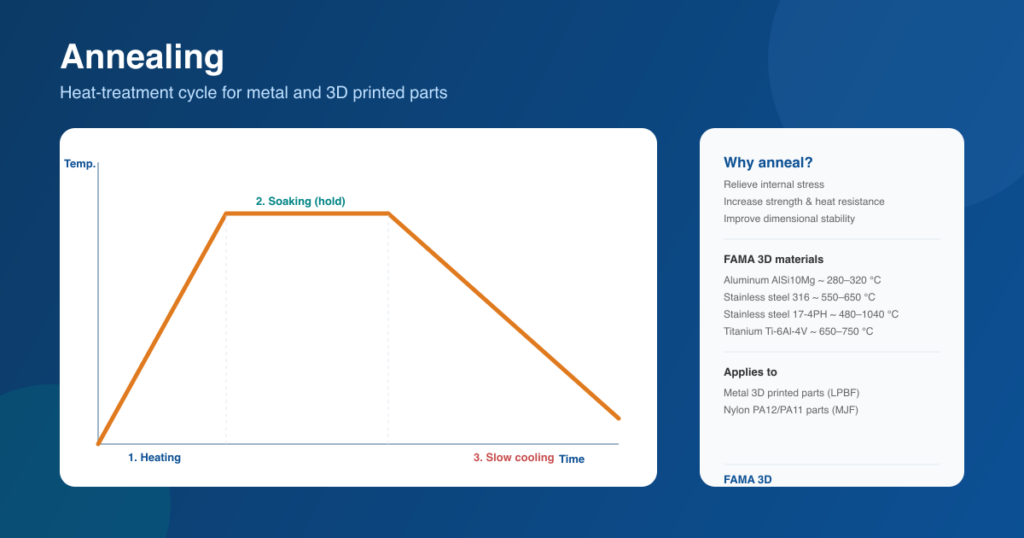
Annealing is a controlled heat-treatment process in which a material is heated to a specific temperature, held at that temperature for a set period (soaking), and then cooled slowly, usually inside the oven or furnace itself. The goal is to relax internal stresses that built up during manufacturing — casting, machining, welding, or, in the case of 3D printing, layer-by-layer deposition — and to allow the material’s internal structure to reorganize into a more stable, less brittle state.
INSTANT 3D PRINTING QUOTE
The term comes from metallurgy, but the same underlying principle — heat, hold, cool slowly — applies to thermoplastics used in 3D printing, glass, and several other materials.
How Does Annealing Work?
Every annealing cycle follows the same three stages:
- Heating: the part is brought up to a target temperature, below the material’s melting point, at a controlled rate to avoid introducing new stress.
- Soaking: the part is held at that temperature long enough for the internal structure to reorganize — recrystallization and grain growth in metals, structural reorganization in semi-crystalline plastics like Nylon.
- Slow cooling: the part is cooled gradually, often inside the same oven, to avoid reintroducing thermal stress or distortion.
The exact temperature and soak time depend entirely on the material: too low and the treatment has little effect, too high or too fast and the part can warp, shrink, or deform.
Annealing vs Quenching vs Tempering vs Normalizing
These terms are often confused, but they describe different heat treatments:
- Annealing: slow, controlled cooling to soften the material and relieve stress.
- Quenching: rapid cooling (in water, oil, or air) used to harden a metal, often followed by tempering.
- Tempering: a lower-temperature reheating step applied after quenching to reduce brittleness while keeping most of the added hardness.
- Normalizing: similar to annealing, but the metal is cooled in open air rather than inside the furnace, producing a slightly harder and more uniform grain structure.
Annealing Temperatures for FAMA 3D’s Materials
Annealing temperature varies widely by alloy and process. For the metal alloys we work with at FAMA 3D using LPBF, as a general reference:
| Material (process) | Typical stress-relief annealing temperature |
|---|---|
| Aluminum AlSi10Mg (LPBF) | ~ 280 – 320 °C |
| Stainless steel 316 (LPBF) | ~ 550 – 650 °C |
| Stainless steel 17-4PH / 1.4542 (LPBF) | solution ~1040 °C + precipitation hardening (H900) ~480 °C |
| Titanium Ti-6Al-4V (LPBF) | ~ 650 – 750 °C, under controlled atmosphere or vacuum |
These are indicative ranges only: the exact thermal cycle depends on part geometry, wall thickness, and the mechanical requirements, and should always be verified case by case.
Annealing Metal 3D Printed Parts (LPBF)
Metal parts produced with laser powder bed fusion (LPBF) build up significant internal stress layer by layer, due to rapid, localized melting and cooling. A stress-relief annealing cycle, performed before removing the part from the build plate, is standard practice for the metals we work with: titanium, aluminum AlSi10Mg, and stainless steel (316 and 17-4PH). Without it, parts can warp or even crack once separated from the build plate.
Annealing Nylon Parts Printed with Multi Jet Fusion
Nylon PA12 and PA11 parts built with Multi Jet Fusion are already supported by unfused powder during the build, so they suffer far less from warping than FDM parts. A controlled heat-treatment cycle can still be useful to relieve residual stress and even out mechanical properties, especially on reinforced grades like Nylon PA12 GB (glass-bead filled). TPU, being an elastomer, is rarely annealed.
Frequently Asked Questions
Is annealing the same as tempering?
No. Annealing softens a material and relieves stress through slow cooling; tempering is a secondary, lower-temperature step used after quenching to reduce brittleness while retaining most of the hardness gained.
Does annealing always make a part stronger?
Not exactly — annealing generally increases stiffness and heat resistance, but for many materials it also reduces impact toughness, so the part becomes more rigid but sometimes more brittle. That’s why the thermal cycle should always be chosen based on the part’s end application.
What is simulated annealing?
Simulated annealing is an optimization algorithm used in computer science and machine learning, named after this metallurgical process because it uses a similar principle of gradually “cooling” a search process to settle on a stable solution. It is unrelated to material heat treatment.
What does annealing mean in molecular biology (PCR)?
In PCR, “annealing” refers to the step where primers bind (hybridize) to a single strand of DNA at a specific temperature — a different, unrelated use of the same word borrowed from materials science.
Need stress-relief annealing for a stainless steel, aluminum, or titanium part, or heat treatment for a nylon PA12/PA11 component? Contact FAMA 3D: browse all the materials we work with and we’ll help you choose the right post-processing for the performance your part needs.
INSTANT 3D PRINTING QUOTE
