
Young’s Modulus: What It Is, Formula, and Values for 3D Printing Materials
Young’s modulus (or modulus of elasticity) tells you how much a material deforms under stress before returning to shape or breaking: the higher it is, the stiffer the material. It’s the first number to check when choosing between PLA, ABS, nylon, resin, or a metal for a part that needs to carry a load. This guide covers what it is, how to calculate it, its unit of measurement, and a table of typical values for the materials most used in 3D printing.
What Is Young’s Modulus?
Young’s modulus, denoted E, measures a material’s stiffness — its resistance to elastic deformation under tension or compression. It’s named after British physicist Thomas Young, who described it in the early 1800s, though the concept had already been outlined earlier by Leonhard Euler.
INSTANT 3D PRINTING QUOTE
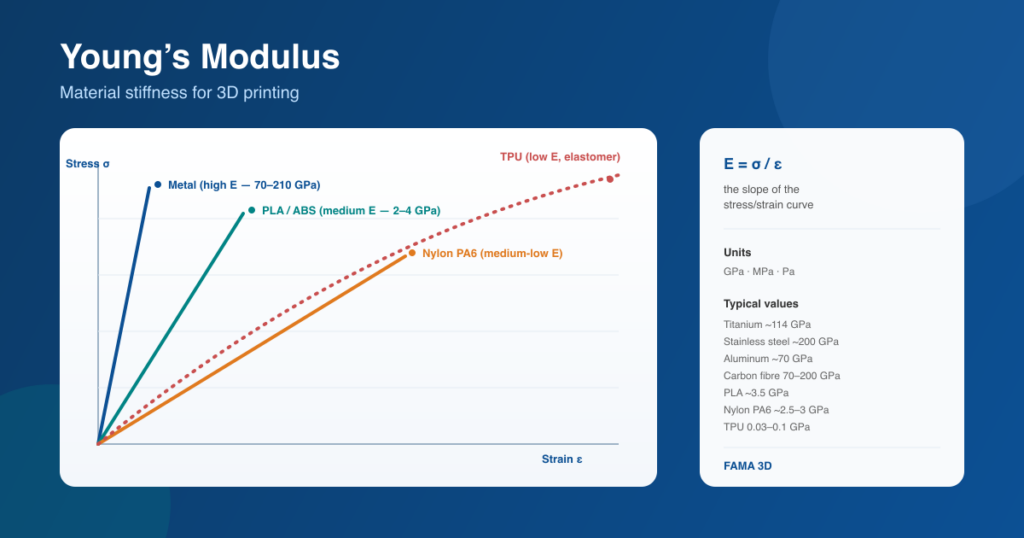
A high Young’s modulus means a material barely deforms under load (steel, titanium); a low value means the material stretches easily before it reacts (TPU, rubber). It only applies within the elastic range — i.e. as long as the material returns to its original shape once the load is removed.
Young’s Modulus Formula
Young’s modulus is the ratio between applied stress and the resulting strain:
E = σ / ε
where:
- σ (stress) = F / A, the applied force (F) divided by the cross-sectional area of the specimen (A)
- ε (strain) = ΔL / L₀, the elongation (ΔL) divided by the original length (L₀)
In practice, Young’s modulus is the slope of the linear portion of the stress-strain curve from a tensile test: the steeper the line, the stiffer the material.
Unit of Measurement
Since it’s a ratio between a pressure (σ) and a dimensionless number (ε), Young’s modulus is measured in pascals (Pa). Because values are very high for most materials, the common multiples are used instead:
- MPa (megapascal) = 10⁶ Pa — used for more flexible materials, such as elastomers
- GPa (gigapascal) = 10⁹ Pa — the standard unit for plastics, composites, and metals
It’s also common to see values in psi (pound-force per square inch): 1 GPa is roughly 145,038 psi. A material with a modulus “around 100” GPa (100,000 MPa) is already in the range of lightweight metals, such as some titanium alloys.
How to Calculate Young’s Modulus: an Example
Picture a specimen under a tensile test: the applied force (F), the cross-sectional area (A), and the elongation (ΔL) relative to the original length (L₀) are recorded. To get E:
- calculate the stress σ = F / A;
- calculate the strain ε = ΔL / L₀;
- divide σ by ε within the portion of the curve that is still linear (the elastic range).
In practice this is rarely computed by hand: tensile testing machines record the stress-strain curve automatically and return the value of E directly, or the value is simply taken from the material’s technical data sheet (TDS).
Static vs Dynamic Young’s Modulus
The static Young’s modulus is measured with a traditional tensile or flexural test, applying a slowly increasing load. The dynamic Young’s modulus, on the other hand, is derived from non-destructive methods — such as ultrasonic excitation or measuring a part’s resonant frequency — and describes stiffness under fast loads or vibration.
For metals, the two values are nearly identical. For plastics and 3D printed polymers, the dynamic modulus can come out higher than the static one, because these materials behave viscoelastically: their stiffness also depends on how fast they’re loaded.
Young’s Modulus Table for 3D Printing Materials
Here is a table with indicative Young’s modulus values for the materials most commonly used in 3D printing and mechanical engineering:
| Material | Young’s Modulus (E) |
|---|---|
| PLA | ~ 2.3 – 4.1 GPa |
| ABS | ~ 1.5 – 2.9 GPa |
| PETG | ~ 1.5 – 2.2 GPa |
| Nylon (PA6 / PA12) | ~ 1.7 – 3 GPa (dry; drops with moisture absorption) |
| SLA/DLP resin | ~ 1.5 – 3 GPa |
| TPU (elastomer) | ~ 0.01 – 0.1 GPa |
| Carbon fibre composite | ~ 70 – 200 GPa |
| Wood (along the grain) | ~ 9 – 11 GPa |
| Aluminum | ~ 69 – 72 GPa |
| Titanium (Ti-6Al-4V) | ~ 110 – 114 GPa |
| Steel / Stainless steel | ~ 190 – 210 GPa |
| Glass | ~ 60 – 90 GPa |
| Air and gases | negligible / not measurable (offer no resistance to tension) |
Note: these are average reference values from technical literature. The actual Young’s modulus of a 3D printed part also depends on print orientation, infill percentage, and process parameters, so it can vary noticeably from the bulk material value.
Young’s Modulus of PLA
PLA is among the stiffest plastics commonly used in 3D printing, with a Young’s modulus of roughly 2.3 to 4.1 GPa, depending on formulation and print settings. It’s stiffer than ABS and PETG, but also more brittle: it deforms very little before breaking, which makes it excellent for rigid prototypes and a poor choice for parts that need to flex or absorb impact.
Young’s Modulus of Nylon PA6
Dry nylon PA6 has a Young’s modulus of around 2.5 – 3 GPa, comparable to PLA, but with much higher toughness and fatigue resistance: it deforms more before breaking and is less brittle on impact. The value drops significantly if the material absorbs moisture from the environment, which PA6 is particularly prone to — so it should always be printed and dried according to the manufacturer’s recommendations.
Why Young’s Modulus Matters in 3D Printing
Knowing a material’s Young’s modulus lets you predict how a 3D printed part will behave under load before it’s even produced: it helps size wall thickness and ribs, choose between a stiff material (metal, PLA, carbon fibre) and a flexible one (TPU), and avoid excessive deformation or failure in service. It’s also a key input for anyone running FEM simulations, where the elastic modulus is one of the main parameters used to predict a component’s structural response.
At FAMA 3D we work daily with a wide range of materials — from thermoplastics like nylon and ABS, to resins and carbon fibre composites, all the way to metals such as aluminum, stainless steel, and titanium — and we help clients pick the right stiffness for their application, balancing Young’s modulus, weight, and cost.
Frequently Asked Questions
Is Young’s modulus the same in tension and compression?
For most homogeneous materials the two values are very close, but for 3D printed parts (especially polymers) they can differ due to the anisotropy introduced by the layer-by-layer printing process.
Is a higher Young’s modulus always better?
No — it depends on the application. A high modulus suits rigid, structural parts, while a lower modulus is preferable for flexible components, gaskets, or parts that need to absorb impact.
Where can I find the Young’s modulus of a specific material?
The most reliable source is the manufacturer’s technical data sheet (TDS) for the filament, resin, or metal powder, or a tensile test performed to ISO 527 or ASTM D638.
Need advice on which material to use for your next project? Contact FAMA 3D: we’ll help you pick the material with the Young’s modulus that matches the performance your part requires.
INSTANT 3D PRINTING QUOTE
